
In this guide
The pause can be part of the character
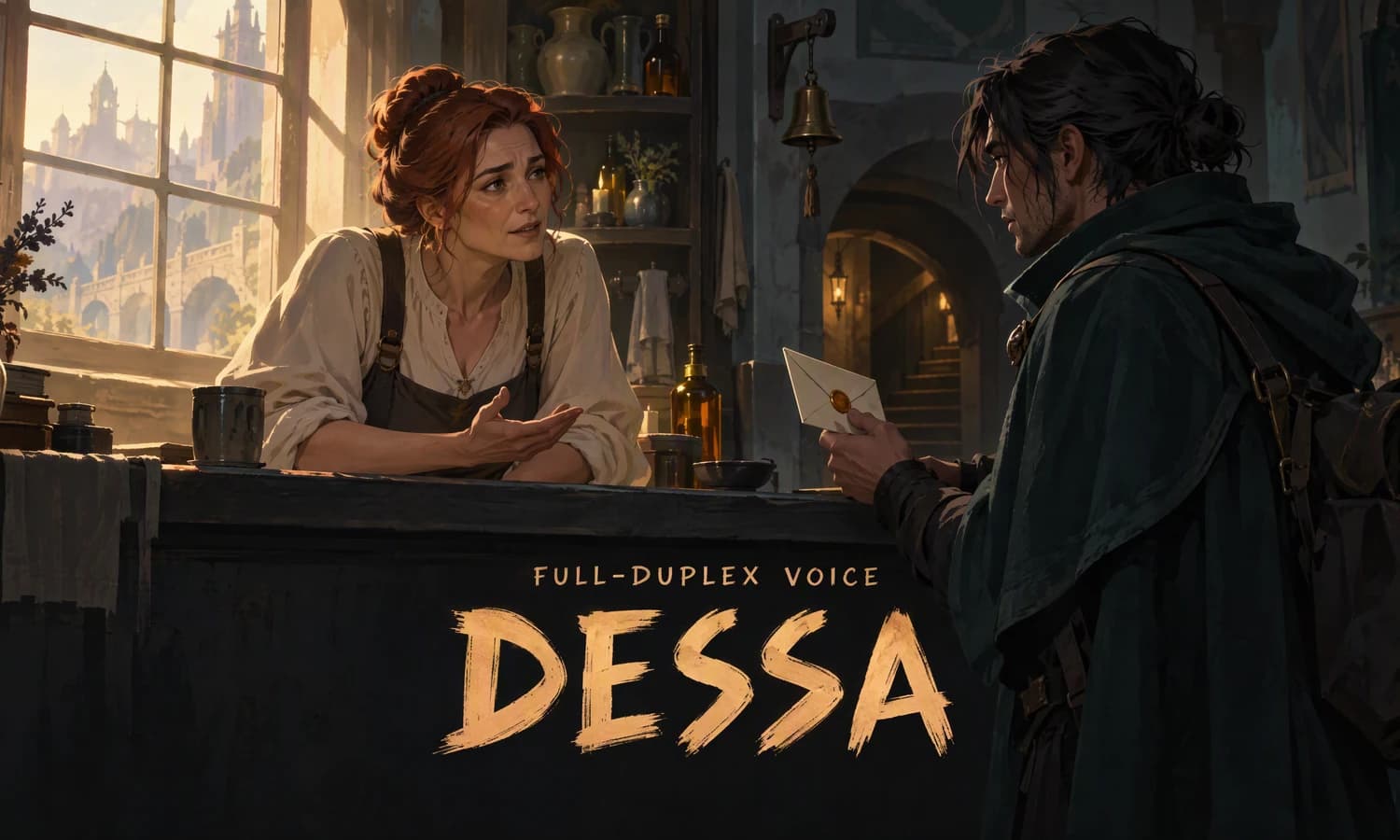
You ask the innkeeper whether she saw the missing courier. Before answering, she takes a breath and lowers her voice. In a spoken roleplaying scene, the timing can carry as much meaning as the sentence. A laugh, a hesitation, or a quick acknowledgement can make an NPC feel present.
Block describes Dessa as a speech-to-speech conversation model trained from human speech without text or pretrained models. It is full-duplex, meaning it can listen and speak at the same time. Those are Block’s descriptions; this article explores their possible value for an AI D&D game master, rather than announcing Dessa support in Playworlds.
Let conversational timing support the scene
A voice GM needs to know when to continue describing a room and when the player is trying to act. Imagine the innkeeper beginning a story just as you ask to check the cellar. A satisfying conversation would acknowledge the new action and give you a chance to finish explaining it.
Block’s page presents live conversation recordings and describes Dessa’s ability to hear and produce expressive speech. For roleplaying, our proposed test would examine whether pauses and brief responses help a scene flow. Expressiveness should fit the character and situation; every sentence does not need a gasp, a joke, or an interruption.
Keep a spoken reaction separate from a game decision
A player laughing at a suspicious innkeeper has not agreed to follow her into the cellar. Saying ‘wait’ during narration should give the player room to speak. A spoken AI DM would need to preserve those ordinary distinctions, especially when both sides can talk at once.
In our proposed design, casual acknowledgements would support the conversation, while consequential actions would still receive an explicit ruling. Before spending a potion or attacking someone, the game needs a clear player intent and a resolved outcome. The voice can convey surprise or tension while leaving that decision with the player.
Give the voice a campaign to remember
Natural speech alone does not establish a character sheet, a rules engine, or reliable campaign memory. If the courier’s disappearance was discussed last session, the innkeeper’s next conversation should use the same established facts. If the player never revealed a clue, her dialogue should respect that limit.
Before considering Dessa for a game, we would need to verify which interfaces could connect its conversation to reviewed scene facts and recorded actions. We would also need to test what happens when speech stops midway through a ruling. The public demos do not establish an RPG integration contract or demonstrate these gameplay behaviors.
Test what happens when the player speaks
For a small evaluation, use one innkeeper, one missing courier, and one hidden cellar. Ask a question, interrupt a description, change your mind before committing an action, and return after a pause. Check that the GM hears the complete request, stops appropriately, and keeps the scene’s facts consistent.
Also ask for a quieter voice or a repeated sentence, and offer a text way to inspect important names and outcomes. These are proposed experience checks, not verified Dessa features. As checked October 27, Block’s page offers a waitlist and limited early access for safety researchers; it does not establish general production API availability for a Playworlds integration.
Bring the innkeeper’s mystery into Playworlds today
You can explore the same roleplaying idea as a text adventure: an inn where the cellar bell rings whenever a guest tells a lie. Your character carries the missing courier’s unopened letter. Start by asking the innkeeper who stayed in the room above yours, then decide what you want to reveal.
Dessa suggests an interesting research direction for spoken NPCs, while Playworlds’ worlds, characters, dice, and saved solo adventures provide a place to try the story now. A better AI D&D experience gives the player time to think, a world that responds, and a character whose next answer is worth hearing.